The 2019 project
In grade 10 at the Nazarbayev Intellectual School of Chemistry and Biology in Oskemen, I ran an experimental study on removing textile dyes from wastewater, titled “Purification of Wastewater from Dye Production”. I worked under two supervisors: my school chemistry teacher, and an associate professor from the Department of Chemistry at S. Amanzholov East Kazakhstan State University. I prepared four model waters, each mixing two or three commercial dyes from one application class (direct, acid, disperse, and reactive), and treated each water in three ways: coagulation with an iron(III) or an aluminium salt, filtration through a bed of sulfonated coal, and the two processes in sequence. I followed the colour of each sample with a photometer and recorded the pH before and after treatment.
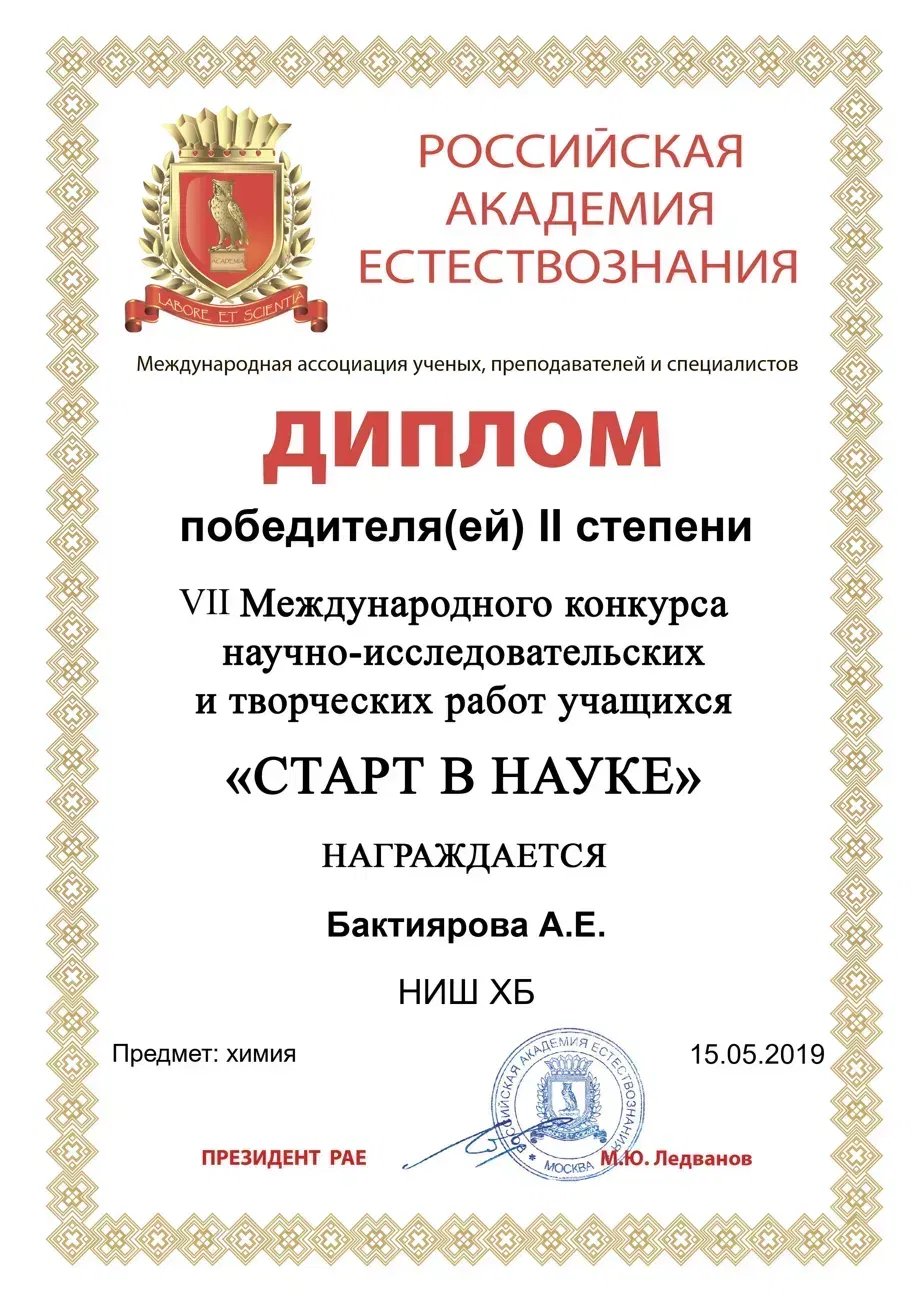
The paper, written in Russian, received a Diploma of the Second Degree in the chemistry category at the VII International Competition of Student Research and Creative Works “Start in Science”, held by the Russian Academy of Natural History, on 15 May 2019.
Why I reviewed it
I did not open the paper again between 2019 and 2026. When I reread it, I found that it records what I did and leaves out why I made each choice, and I had kept no notes on that reasoning in 2019. Since then I have learned the standards that peer-reviewed water treatment research is held to, and I wanted to check my first project against those standards in public, with every gap written down. I completed the review in September 2026 for two groups of readers: students planning their first experimental project, and researchers who want to see how I work.
How the review works
I applied thirteen criteria to the manuscript. They cover whether another researcher could reproduce the experiment from the text, whether the measurements support the conclusions drawn from them, and whether the paper describes the recommended treatment in enough detail for someone to use it. For each criterion I recorded what the paper reports and what a complete report of the same experiment would add. The comparison throughout is with the standards of published research; judged by the standards for school research projects, the paper met them.
The experimental design
I measured each treatment alone and then both in sequence, against untreated water, across four chemically different groups of dyes. This arrangement shows how much each stage contributes, and it matches the two-stage treatment used on industrial effluent, where one stage removes most of the load and a second stage removes the rest. The main result of the paper is that coagulation followed by sorption removed more colour than either treatment alone, and this result held for all four dye groups. The design supports that comparison.
Gaps in the measurement and reporting
The paper does not support exact statements about how much dye was removed. A removal percentage requires a calibrated link between the instrument reading and the dye concentration, a stated uncertainty, and repeated measurements, and my 2019 paper has none of these. The largest gaps are these:
- Measurement method. The paper does not state the wavelength, the instrument, or a calibration curve. Each model water mixed several dyes whose absorption spectra overlap, so a single reading cannot be split into the contribution of each dye.
- Doses. I recorded millilitres of coagulant and grams of sorbent per sample. Another laboratory needs the concentration of the stock solution and a dose per litre of water to repeat the experiment.
- Replication. Every condition was measured once, so the paper cannot show whether iron and aluminium, which gave close results, performed differently.
- Sorbent capacity. The paper gives the mass of sulfonated coal each sample needed, and does not give how much dye one gram of the coal can hold, which is the figure researchers use to compare sorbents.
The review also records smaller gaps. One section of the paper is titled after the effect of pH, but pH was only recorded, never varied under control. The paper measured colour only, without organic load, leftover coagulant metal, or the volume of sludge produced. The experiments used clean prepared dye solutions, while dyehouse effluent is salty, alkaline, and warm. The paper calls sulfonated coal inexpensive without a cost calculation. All twenty-five sources were Russian-language books, several published between 1973 and 1996, with no journal articles and none of the standard adsorption models used in the field.
Rereading the data raised two chemistry questions the 2019 paper did not address. Sulfonated coal carries negatively charged groups, and three of my four dye mixtures were also negatively charged, so electrostatic attraction cannot explain why the coal held those dyes; the redesign includes tests that identify the binding mechanism. The pH of every water after passing through the coal ended up close to the pH of the coal itself, whatever its starting pH, which suggests the coal buffers the water, and this can be tested.
The rivers in the introduction
My 2019 introduction presented the study as a response to contamination of the Irtysh and Ulba rivers in East Kazakhstan. Published measurements from those rivers attribute the contamination mainly to mining and non-ferrous metallurgy, with cadmium, zinc, copper, and other metals above permitted levels, and do not name textile dyes as a source. The review corrects the problem statement: dye wastewater is a problem in textile-manufacturing regions, and the main water quality problem in East Kazakhstan is metal contamination.
How I would run the study now
The redesign keeps the original research question and the two-stage treatment and changes what is measured and how it is reported. It narrows the study to one reactive dye; builds a calibration curve first, so that every result is reported in milligrams per litre; runs every condition at least three times; tests coagulation across a controlled pH range with the standard jar test; measures how fast the sorbent takes up dye and how much it can hold; characterises the surface of the sorbent; adds measurements of organic load, leftover metal, and sludge; repeats the treatment in salty, alkaline water closer to dyehouse effluent; and calculates the cost per cubic metre of treated water, including reuse of the sorbent. The work is set out in seven phases taking about ten to twelve weeks of part-time laboratory work, close to the time the original project took, and three of the procedures need equipment found in a university chemistry department.
Advice for students planning a first project
The review lists practices that apply to a first experimental project in any field:
- Decide how you will measure your key quantity, against what reference, and with what precision, before you collect any data. A measurement method usually cannot be added to data you have already collected.
- Report quantities in units another laboratory can use, such as concentrations, and check whether someone elsewhere could repeat your experiment from your text alone.
- Measure each condition at least three times, so you know the spread of your results and can tell whether two results differ.
- If your introduction names a factor as important, run an experiment that changes that factor and records the response.
- Measure what your process leaves behind, such as sludge or used material, along with what it removes.
- Study one system in depth before comparing several, so your results can be compared with published work.
- If your aim describes a method as cheap, fast, or efficient, measure the cost, the time, or the efficiency.
- Read current peer-reviewed articles early, including English-language ones, to find out whether your question has been answered and how other researchers report their results.
- Cite each source at the point where you use it, and check that the source says what you claim.
- Keep a dated record of every reading, including the runs you discarded and the reason for discarding them.
- Limit each conclusion to the conditions you tested.
Where the work led
Research at school was the start of a path that has since taken me to academic programmes at Stanford University, Johns Hopkins University, and the University of Massachusetts, each on a full scholarship. I studied at Leipzig University in Germany, which was founded in 1409 and is one of the oldest universities in the country; its alumni include Gottfried Wilhelm Leibniz, Johann Wolfgang von Goethe, Friedrich Nietzsche, and Angela Merkel. And I am now continuing my academic endeavours in the US.
I am building three open, computational research projects in biomedical data: a resource linking genetic variants to resistance to newer and repurposed tuberculosis drugs, the first open Kazakh biomedical language resource, and a knowledge base of the chemistry and traditional use of Central Asian medicinal plants. I build each of them under the practices listed above, with the measurement fixed before data collection, versioned repositories holding the raw records, open licences, and datasets archived under permanent identifiers.
The full review
The full review and the 2019 competition diploma are below. Students planning a first project can use the thirteen criteria in Section 3 and the practices in Section 8 of the review as a checklist.